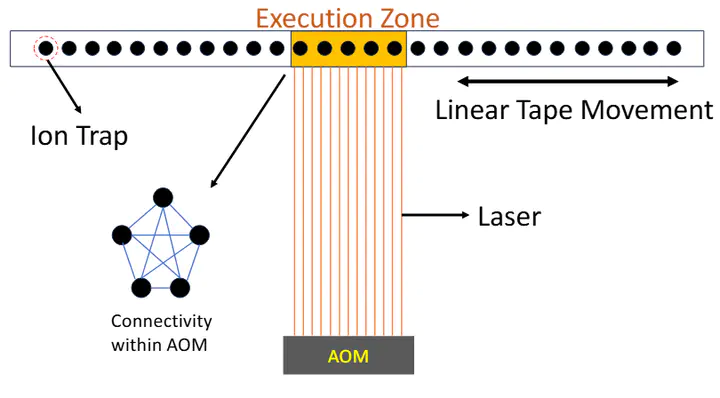
 Linear Trapped-Ion quantum computer
Abstract
Ion traps stand at the forefront of quantum hardware technology, presenting unparalleled benefits for quantum computing, such as high-fidelity gates, extensive connectivity, and prolonged coherence times. In this context, we explore the critical role of shuttling operations within these systems, especially their influence on the fidelity loss and elongated execution times. To address these challenges, we have developed BOSS, an efficient blocking algorithm tailored to enhance shuttling efficiency. This optimization not only bolsters the shuttling process but also elevates the overall efficacy of ion trap devices. We experimented on multiple applications using two qubit gates up to 4000+ and qubits ranging from 64 to 78. Our method significantly reduces the number of shuttles on most applications, with a maximum reduction of 96.1%. Additionally, our investigation includes simulations of realistic experimental parameters that incorporate sympathetic cooling, offering a higher fidelity and a refined estimate of execution times that align more closely with practical scenarios.

Xian Wu
PhD Student (2024)
I obtained my BS in Computer Science from Sun Yat-sen University under the supervision of Prof. Yanghui Rao. I obtained my MS degree in Computer Science from Sun Yat-sen University under the supervision of Prof. Lvzhou Li. My research interests include quantum computation and quantum architecture.
Chenghong Zhu
PhD Student (2023)
I obtained my BS and MS degrees in computer science from the University of Melbourne. My research interests include distributed quantum computing, quantum entanglement and quantum machine learning.
Xin Wang
Associate Professor
Prof. Xin Wang founded the QuAIR Lab at HKUST (Guangzhou) in June 2023. His research aims to advance our understanding of the limits of information processing with quantum systems and the potential of quantum artificial intelligence. His current interests include quantum algorithms, quantum resource theory, quantum machine learning, quantum computer architecture, and quantum error processing. Prior to establishing the QuAIR Lab, Prof. Wang was a Staff Researcher at the Institute for Quantum Computing at Baidu Research, where he focused on quantum computing research and the development of the Baidu Quantum Platform. Notably, he led the development of Paddle Quantum, a Python library for quantum machine learning. From 2018 to 2019, he was a Hartree Postdoctoral Fellow at the Joint Center for Quantum Information and Computer Science (QuICS) at the University of Maryland, College Park. Prof. Wang received his Ph.D. in quantum information from the University of Technology Sydney in 2018, under the supervision of Prof. Runyao Duan and Prof. Andreas Winter. He obtained his B.S. in mathematics (Wu Yuzhang Honors) from Sichuan University in 2014.