MUSS-TI: Multi-level Shuttle Scheduling for Large-Scale Entanglement Module Linked Trapped-Ion
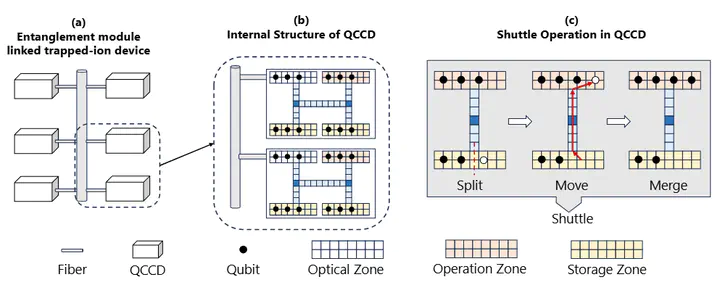 Overview of EML-QCCD
Abstract
Abstract Trapped-ion computing is a leading architecture in the pursuit of scalable and high fidelity quantum systems. Modular quantum architectures based on photonic interconnects offer a promising path for scaling trapped ion devices. In this design, multiple Quantum Charge Coupled Device (QCCD) units are interconnected through entanglement module. Each unit features a multi-zone layout that separates functionalities into distinct areas, enabling more efficient and flexible quantum operations. However, achieving efficient and scalable compilation of quantum circuits in such entanglement module linked Quantum Charge-Coupled Device (EML-QCCD) remains a primary challenge for practical quantum applications. In this work, we propose a scalable compiler tailored for large-scale trapped-ion architectures, with the goal of reducing the shuttling overhead inherent in EML-QCCD devices. MUSS-TI introduces a multi-level scheduling approach inspired by multi-level memory scheduling in classical computing. This method is designed to be aware of the distinct roles of different zones and to minimize the number of shuttling operations required in EML-QCCD systems. We demonstrate that EML-QCCD architectures are well-suited for executing large-scale applications. Our evaluation shows that MUSS-TI reduces shuttle operations by 41.74% for applications with 30–32 qubits, and by an average of 73.38% and 59.82% for applications with 117–128 qubits and 256–299 qubits, respectively.
Xian Wu
PhD Student (2024)
I obtained my BS in Computer Science from Sun Yat-sen University under the supervision of Prof. Yanghui Rao. I obtained my MS degree in Computer Science from Sun Yat-sen University under the supervision of Prof. Lvzhou Li. My research interests include quantum computation and quantum architecture.
Chenghong Zhu
PhD Graduate
Xin Wang
Associate Professor
Prof. Xin Wang founded the QuAIR Lab at HKUST (Guangzhou) in June 2023. His research aims to advance our understanding of the limits of information processing with quantum systems and the potential of quantum artificial intelligence. His current interests include quantum algorithms, quantum resource theory, quantum machine learning, quantum computer architecture, and quantum error processing. Prior to establishing the QuAIR Lab, Prof. Wang was a Staff Researcher at the Institute for Quantum Computing at Baidu Research, where he focused on quantum computing research and the development of the Baidu Quantum Platform. Notably, he led the development of Paddle Quantum, a Python library for quantum machine learning. From 2018 to 2019, he was a Hartree Postdoctoral Fellow at the Joint Center for Quantum Information and Computer Science (QuICS) at the University of Maryland, College Park. Prof. Wang received his Ph.D. in quantum information from the University of Technology Sydney in 2018, under the supervision of Prof. Runyao Duan and Prof. Andreas Winter. He obtained his B.S. in mathematics (Wu Yuzhang Honors) from Sichuan University in 2014.