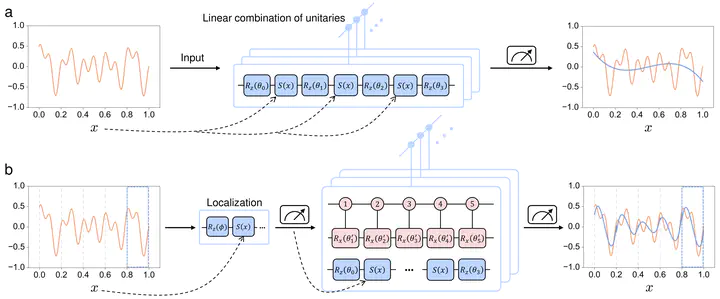
 Overview of PQCs for approximating continuous functions.
Abstract
Parameterized quantum circuits (PQCs) have emerged as a promising approach for quantum neural networks. However, understanding their expressive power in accomplishing machine learning tasks remains a crucial question. This paper investigates the expressivity of PQCs for approximating general multivariate function classes. Unlike previous Universal Approximation Theorems for PQCs, which are either nonconstructive or rely on parameterized classical data processing, we explicitly construct data re-uploading PQCs for approximating multivariate polynomials and smooth functions. We establish the first non-asymptotic approximation error bounds for these functions in terms of the number of qubits, quantum circuit depth, and number of trainable parameters. Notably, we demonstrate that for approximating functions that satisfy specific smoothness criteria, the quantum circuit size and number of trainable parameters of our proposed PQCs can be smaller than those of deep ReLU neural networks. We further validate the approximation capability of PQCs through numerical experiments. Our results provide a theoretical foundation for designing practical PQCs and quantum neural networks for machine learning tasks that can be implemented on near-term quantum devices, paving the way for the advancement of quantum machine learning.
Xin Wang
Associate Professor
Prof. Xin Wang founded the QuAIR Lab at HKUST (Guangzhou) in June 2023. His research aims to advance our understanding of the limits of information processing with quantum systems and the potential of quantum artificial intelligence. His current interests include quantum algorithms, quantum resource theory, quantum machine learning, quantum computer architecture, and quantum error processing. Prior to establishing the QuAIR Lab, Prof. Wang was a Staff Researcher at the Institute for Quantum Computing at Baidu Research, where he focused on quantum computing research and the development of the Baidu Quantum Platform. Notably, he led the development of Paddle Quantum, a Python library for quantum machine learning. From 2018 to 2019, he was a Hartree Postdoctoral Fellow at the Joint Center for Quantum Information and Computer Science (QuICS) at the University of Maryland, College Park. Prof. Wang received his Ph.D. in quantum information from the University of Technology Sydney in 2018, under the supervision of Prof. Runyao Duan and Prof. Andreas Winter. He obtained his B.S. in mathematics (Wu Yuzhang Honors) from Sichuan University in 2014.