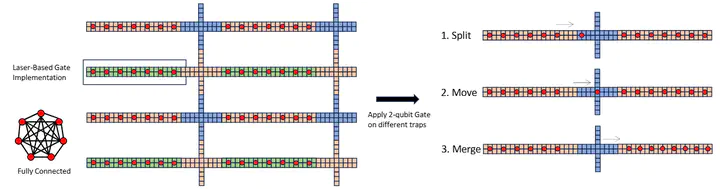
 A modular Quantum Charge Coupled Device (QCCD) example
Abstract
The Quantum Charge-Coupled Device (QCCD) architecture is a modular design to expand trapped-ion quantum computer that relies on the coherent shuttling of qubits across an array of segmented electrodes. Leveraging trapped ions for their long coherence times and high-fidelity quantum operations, QCCD technology represents a significant advancement toward practical, large-scale quantum processors. However, shuttling increases thermal motion and consistently necessitates qubit swaps, significantly extend execution time and negatively affect application success rates. In this paper, we introduce S-SYNC – a compiler designed to co-optimize the number of shuttling and swapping operations. S-SYNC exploits the unique properties of QCCD and incorporates generic SWAP operations to efficiently manage shuttle and SWAP counts simultaneously. Building on the static topology formulation of QCCD, we develop scheduling heuristics to enhance overall performance. Our evaluations demonstrate that our approach reduces the shuttling number by 3.69x on average and improves the success rate of quantum applications by 1.73x on average. Moreover, we apply S-SYNC to gain insights into executing applications across various QCCD topologies and to compare the trade-offs between different initial mapping methods.
Chenghong Zhu
PhD Student (2023)
I obtained my BS and MS degrees in computer science from the University of Melbourne. My research interests include distributed quantum computing, quantum entanglement and quantum machine learning.

Xian Wu
PhD Student (2024)
I obtained my BS in Computer Science from Sun Yat-sen University under the supervision of Prof. Yanghui Rao. I obtained my MS degree in Computer Science from Sun Yat-sen University under the supervision of Prof. Lvzhou Li. My research interests include quantum computation and quantum architecture.
Xin Wang
Associate Professor
Prof. Xin Wang founded the QuAIR Lab at HKUST (Guangzhou) in June 2023. His research aims to advance our understanding of the limits of information processing with quantum systems and the potential of quantum artificial intelligence. His current interests include quantum algorithms, quantum resource theory, quantum machine learning, quantum computer architecture, and quantum error processing. Prior to establishing the QuAIR Lab, Prof. Wang was a Staff Researcher at the Institute for Quantum Computing at Baidu Research, where he focused on quantum computing research and the development of the Baidu Quantum Platform. Notably, he led the development of Paddle Quantum, a Python library for quantum machine learning. From 2018 to 2019, he was a Hartree Postdoctoral Fellow at the Joint Center for Quantum Information and Computer Science (QuICS) at the University of Maryland, College Park. Prof. Wang received his Ph.D. in quantum information from the University of Technology Sydney in 2018, under the supervision of Prof. Runyao Duan and Prof. Andreas Winter. He obtained his B.S. in mathematics (Wu Yuzhang Honors) from Sichuan University in 2014.