Abstract
The difficulty of simulating quantum dynamics depends on the norm of the Hamiltonian. When the Hamiltonian varies with time, the simulation complexity should only depend on this quantity instantaneously. We develop quantum simulation algorithms that exploit this intuition. For sparse Hamiltonian simulation, the gate complexity scales with the L 1 norm ∫ 0 t d $τ$ ‖ H ( $τ$ ) ‖ max , whereas the best previous results scale with t max $τ$ ∈ [ 0 , t ] ‖ H ( $τ$ ) ‖ max . We also show analogous results for Hamiltonians that are linear combinations of unitaries. Our approaches thus provide an improvement over previous simulation algorithms that can be substantial when the Hamiltonian varies significantly. We introduce two new techniques: a classical sampler of time-dependent Hamiltonians and a rescaling principle for the Schrödinger equation. The rescaled Dyson-series algorithm is nearly optimal with respect to all parameters of interest, whereas the sampling-based approach is easier to realize for near-term simulation. These algorithms could potentially be applied to semi-classical simulations of scattering processes in quantum chemistry.
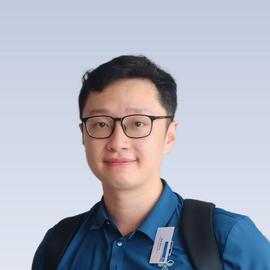
Xin Wang
Associate Professor
Prof. Xin Wang founded the QuAIR Lab at HKUST (Guangzhou) in June 2023. His research aims to advance our understanding of the limits of information processing with quantum systems and the potential of quantum artificial intelligence. His current interests include quantum algorithms, quantum resource theory, quantum machine learning, quantum computer architecture, and quantum error processing. Prior to establishing the QuAIR Lab, Prof. Wang was a Staff Researcher at the Institute for Quantum Computing at Baidu Research, where he focused on quantum computing research and the development of the Baidu Quantum Platform. Notably, he led the development of Paddle Quantum, a Python library for quantum machine learning. From 2018 to 2019, he was a Hartree Postdoctoral Fellow at the Joint Center for Quantum Information and Computer Science (QuICS) at the University of Maryland, College Park. Prof. Wang received his Ph.D. in quantum information from the University of Technology Sydney in 2018, under the supervision of Prof. Runyao Duan and Prof. Andreas Winter. He obtained his B.S. in mathematics (Wu Yuzhang Honors) from Sichuan University in 2014.