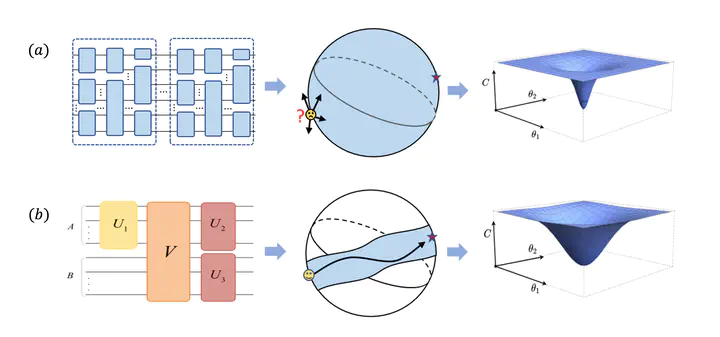
 The difficulty of regular ansatzes in optimization & intro for SEA
Abstract
Variational quantum algorithms (VQAs) are expected to establish valuable applications on near-term quantum computers. However, recent works have pointed out that the performance of VQAs greatly relies on the expressibility of the ansatzes and is seriously limited by optimization issues such as barren plateaus (i.e., vanishing gradients). This work proposes the state efficient ansatz (SEA) for accurate ground state preparation with improved trainability. We show that the SEA can generate an arbitrary pure state with much fewer parameters than a universal ansatz, making it efficient for tasks like ground state estimation. Then, we prove that barren plateaus can be efficiently mitigated by the SEA and the trainability can be further improved most quadratically by flexibly adjusting the entangling capability of the SEA. Finally, we investigate a plethora of examples in ground state estimation where we obtain significant improvements in the magnitude of the cost gradient and the convergence speed.

Xia Liu
Research Associate
I obtained my B.S. in Mathematics from the Qingdao University. I obtained my doctoral degree in Cyberspace Security from University of Chinese Academy of Sciences. My research interests include quantum machine learning and quantum computing.
Xin Wang
Associate Professor
Prof. Xin Wang founded the QuAIR Lab at HKUST (Guangzhou) in June 2023. His research aims to advance our understanding of the limits of information processing with quantum systems and the potential of quantum artificial intelligence. His current interests include quantum algorithms, quantum resource theory, quantum machine learning, quantum computer architecture, and quantum error processing. Prior to establishing the QuAIR Lab, Prof. Wang was a Staff Researcher at the Institute for Quantum Computing at Baidu Research, where he focused on quantum computing research and the development of the Baidu Quantum Platform. Notably, he led the development of Paddle Quantum, a Python library for quantum machine learning. From 2018 to 2019, he was a Hartree Postdoctoral Fellow at the Joint Center for Quantum Information and Computer Science (QuICS) at the University of Maryland, College Park. Prof. Wang received his Ph.D. in quantum information from the University of Technology Sydney in 2018, under the supervision of Prof. Runyao Duan and Prof. Andreas Winter. He obtained his B.S. in mathematics (Wu Yuzhang Honors) from Sichuan University in 2014.