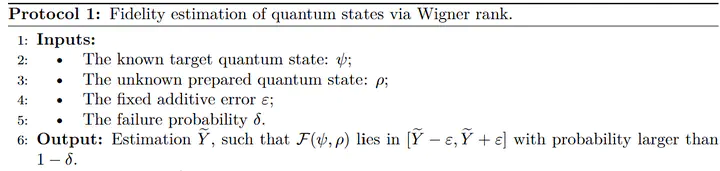
 The protocol of fidelity estimation of quantum states via Wigner rank.
Abstract
Quantum fidelity estimation is essential for benchmarking quantum states and processes on noisy quantum devices. While stabilizer operations form the foundation of fault-tolerant quantum computing, nonstabilizer resources further enable universal quantum computation through state injection. In this work, we propose several efficient quantum fidelity estimation protocols for both quantum states and channels within the resource theory of nonstabilizerness, focusing on qudit systems with odd prime dimensions. Our fidelity estimation algorithms require measuring only a constant number of phase-space point operator expectation values, with operators selected randomly according to an importance weighting scheme tailored to the target state. Notably, we demonstrate that mathematically defined nonstabilizerness measures—such as Wigner rank and mana—quantify the sample complexity of the proposed protocols, thereby endowing them with a clear operational interpretation in the fidelity estimation task. This connection reveals a fundamental trade-off: while fidelity estimation for general quantum states and channels requires resources that scale exponentially with their nonstabilizerness, the task remains tractable for states and channels that admit efficient classical simulation.

Zhiping Liu
Alumni

Xin Wang
Associate Professor
Prof. Xin Wang founded the QuAIR Lab at HKUST (Guangzhou) in June 2023. His research aims to advance our understanding of the limits of information processing with quantum systems and the potential of quantum artificial intelligence. His current interests include quantum algorithms, quantum resource theory, quantum machine learning, quantum computer architecture, and quantum error processing. Prior to establishing the QuAIR Lab, Prof. Wang was a Staff Researcher at the Institute for Quantum Computing at Baidu Research, where he focused on quantum computing research and the development of the Baidu Quantum Platform. Notably, he led the development of Paddle Quantum, a Python library for quantum machine learning. From 2018 to 2019, he was a Hartree Postdoctoral Fellow at the Joint Center for Quantum Information and Computer Science (QuICS) at the University of Maryland, College Park. Prof. Wang received his Ph.D. in quantum information from the University of Technology Sydney in 2018, under the supervision of Prof. Runyao Duan and Prof. Andreas Winter. He obtained his B.S. in mathematics (Wu Yuzhang Honors) from Sichuan University in 2014.