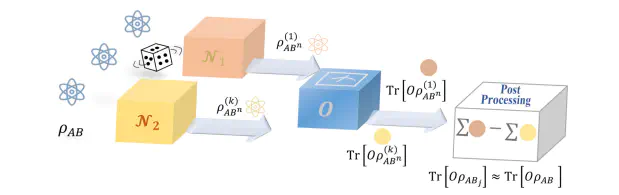
 Illustration of universal virtual broadcasting
Abstract
Quantum broadcasting is central to quantum information processing and characterizes the correlations within quantum states. Nonetheless, traditional quantum broadcasting encounters inherent limitations dictated by the principles of quantum mechanics. In a previous study, Parzygnat et al. [Phys. Rev. Lett. 132, 110203 (2024)] introduced a canonical broadcasting quantum map that goes beyond the quantum no-broadcasting theorem through a virtual process. In this work, we generalize the concept of virtual broadcasting to unilocal broadcasting by incorporating a reference system and introduce protocols that can be approximated using physical operations with minimal cost. First, we propose a universal unilocal protocol enabling multiple parties to share the correlations of a target bipartite state, which is encoded in the expectation value for any observable. Second, we formalize the simulation cost of a virtual quantum broadcasting protocol into a semidefinite programming problem. Notably, we propose a specific protocol with optimal simulation cost for the two-broadcasting scenario, revealing an explicit relationship between simulation cost and the quantum system’s dimension. Moreover, we establish upper and lower bounds on the simulation cost of the virtual 𝑛-broadcasting protocol and demonstrate the convergence of the lower bound to the upper bound as the quantum system’s dimension increases.
Hongshun Yao
PhD Student (2024)
I obtained my BS degree in Mathematics from Nanjing University of Aeronautics and Astronautics and my MS degree in Mathematics from Beihang University. My research interests include quantum information theory and quantum machine learning.

Xia Liu
Research Associate
I obtained my B.S. in Mathematics from the Qingdao University. I obtained my doctoral degree in Cyberspace Security from University of Chinese Academy of Sciences. My research interests include quantum machine learning and quantum computing.
Chengkai Zhu
PhD Student (2023)
I obtained my BS in Applied Mathematics from China Agricultural University under the supervision of Prof. Zhencai Shen. I obtained my MS degree in Cyberspace Security from University of Chinese Academy of Sciences under the supervision of Prof. Zhenyu Huang. My research interests include quantum information theory and quantum computation.

Xin Wang
Associate Professor
Prof. Xin Wang founded the QuAIR Lab at HKUST (Guangzhou) in June 2023. His research aims to advance our understanding of the limits of information processing with quantum systems and the potential of quantum artificial intelligence. His current interests include quantum algorithms, quantum resource theory, quantum machine learning, quantum computer architecture, and quantum error processing. Prior to establishing the QuAIR Lab, Prof. Wang was a Staff Researcher at the Institute for Quantum Computing at Baidu Research, where he focused on quantum computing research and the development of the Baidu Quantum Platform. Notably, he led the development of Paddle Quantum, a Python library for quantum machine learning. From 2018 to 2019, he was a Hartree Postdoctoral Fellow at the Joint Center for Quantum Information and Computer Science (QuICS) at the University of Maryland, College Park. Prof. Wang received his Ph.D. in quantum information from the University of Technology Sydney in 2018, under the supervision of Prof. Runyao Duan and Prof. Andreas Winter. He obtained his B.S. in mathematics (Wu Yuzhang Honors) from Sichuan University in 2014.