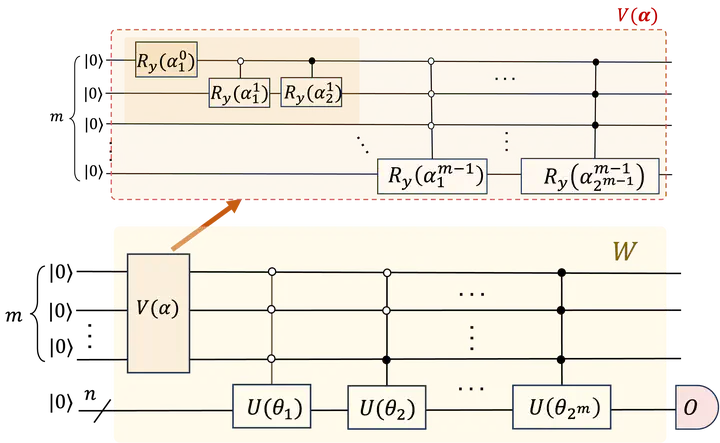
 Illustration of LCQNN architecture.
Abstract
Quantum neural networks (QNNs) offer a promising paradigm for quantum-enhanced machine learning, but their practical application is critically hindered by a severe trade-off between expressivity and trainability. Highly expressive models often suffer from barren plateaus, where gradients vanish exponentially, while architectures designed to avoid this issue risk becoming classically simulable, thus losing any potential for quantum advantage. To navigate this dilemma, we introduce the Linear Combination of Quantum Neural Networks (LCQNN) framework, a novel architecture inspired by the linear combination of unitaries (LCU) technique. LCQNN employs a learnable superposition of multiple QNN blocks, creating a tunable design that mitigates vanishing gradients without collapsing the model's computational power. We provide rigorous theoretical guarantees, showing that gradient variance scales inversely with the number of combined blocks (L). We demonstrate that by adopting structured designs, such as using k-local unitaries or restricting optimization to symmetric subspaces with non-exponential dimensions, the framework ensures trainability while retaining non-trivial quantum features. Numerical experiments validate our theoretical scaling laws and demonstrate the model’s effectiveness on real-world classification tasks. Ultimately, LCQNN provides a principled and scalable methodology for designing QNNs that are both practically trainable and sufficiently powerful for tackling challenging machine learning problems.
Hongshun Yao
PhD Student (2024)
I obtained my BS degree in Mathematics from Nanjing University of Aeronautics and Astronautics and my MS degree in Mathematics from Beihang University. My research interests include quantum information theory and quantum machine learning.

Xia Liu
Research Associate
I obtained my B.S. in Mathematics from the Qingdao University. I obtained my doctoral degree in Cyberspace Security from University of Chinese Academy of Sciences. My research interests include quantum machine learning and quantum computing.
Mingrui Jing
PhD Student (2023)
I obtained my BS and MS degrees in physics from the University of Melbourne. My research interests include distributed quantum computing, quantum entanglement and quantum machine learning.
Guangxi Li
Visiting Scholar
I obtained my BS and MS in Computer Science from University of Electronic Science and Technology of China. I obtained my PhD degree in Computer Science from University of Technology Sydney. My research interests include quantum computing and quantum machine learning.
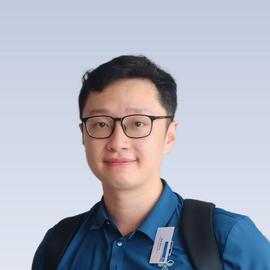
Xin Wang
Associate Professor
Prof. Xin Wang founded the QuAIR Lab at HKUST (Guangzhou) in June 2023. His research aims to advance our understanding of the limits of information processing with quantum systems and the potential of quantum artificial intelligence. His current interests include quantum algorithms, quantum resource theory, quantum machine learning, quantum computer architecture, and quantum error processing. Prior to establishing the QuAIR Lab, Prof. Wang was a Staff Researcher at the Institute for Quantum Computing at Baidu Research, where he focused on quantum computing research and the development of the Baidu Quantum Platform. Notably, he led the development of Paddle Quantum, a Python library for quantum machine learning. From 2018 to 2019, he was a Hartree Postdoctoral Fellow at the Joint Center for Quantum Information and Computer Science (QuICS) at the University of Maryland, College Park. Prof. Wang received his Ph.D. in quantum information from the University of Technology Sydney in 2018, under the supervision of Prof. Runyao Duan and Prof. Andreas Winter. He obtained his B.S. in mathematics (Wu Yuzhang Honors) from Sichuan University in 2014.