Abstract
Unitary transformations formulate the time evolution of quantum states. How to learn a unitary transformation efficiently is a fundamental problem in quantum machine learning. The most natural and leading strategy is to train a quantum machine learning model based on a quantum dataset. Although presence of more training data results in better models, using too much data reduces the efficiency of training. In this work, we solve the problem on the minimum size of sufficient quantum datasets for learning a unitary transformation exactly, which reveals the power and limitation of quantum data. First, we prove that the minimum size of dataset with pure states is $2^n$ for learning an $n$-qubit unitary transformation. To fully explore the capability of quantum data, we introduce a practical quantum dataset consisting of $n+1$ elementary tensor product states that are sufficient for exact training. The main idea is to simplify the structure utilizing decoupling, which leads to an exponential improvement on the size over the datasets with pure states. Furthermore, we show that the size of quantum dataset with mixed states can be reduced to a constant, which yields an optimal quantum dataset for learning a unitary. We showcase the applications of our results in oracle compiling and Hamiltonian simulation. Notably, to accurately simulate a 3-qubit one-dimensional nearest-neighbor Heisenberg model, our circuit only uses $48$ elementary quantum gates, which is significantly less than $4320$ gates in the circuit constructed by the Trotter-Suzuki product formula.
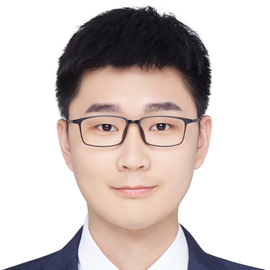
Benchi Zhao
Visiting Scholar
I obtained my MS degree in Physics from Imperial College London. I was an intern at Baidu Research under the supervision of Prof. Xin Wang. I obtained my PhD degree in quantum information at Osaka University. My research interests include quantum error mitigation, quantum information theory and quantum computation.
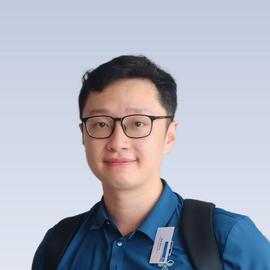
Xin Wang
Associate Professor
Prof. Xin Wang founded the QuAIR Lab at HKUST (Guangzhou) in June 2023. His research aims to advance our understanding of the limits of information processing with quantum systems and the potential of quantum artificial intelligence. His current interests include quantum algorithms, quantum resource theory, quantum machine learning, quantum computer architecture, and quantum error processing. Prior to establishing the QuAIR Lab, Prof. Wang was a Staff Researcher at the Institute for Quantum Computing at Baidu Research, where he focused on quantum computing research and the development of the Baidu Quantum Platform. Notably, he led the development of Paddle Quantum, a Python library for quantum machine learning. From 2018 to 2019, he was a Hartree Postdoctoral Fellow at the Joint Center for Quantum Information and Computer Science (QuICS) at the University of Maryland, College Park. Prof. Wang received his Ph.D. in quantum information from the University of Technology Sydney in 2018, under the supervision of Prof. Runyao Duan and Prof. Andreas Winter. He obtained his B.S. in mathematics (Wu Yuzhang Honors) from Sichuan University in 2014.