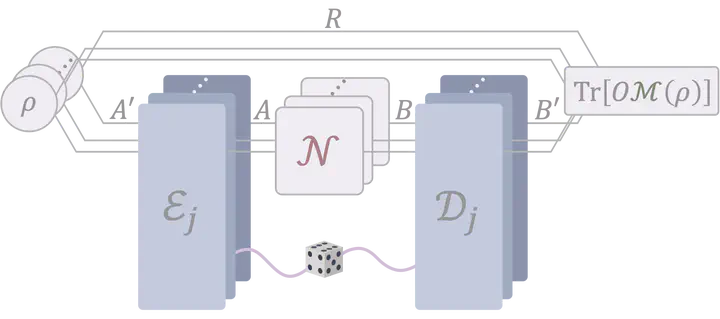
 Sketch of shadow simulation of quantum processes.
Abstract
We introduce the task of shadow process simulation, where the goal is to simulate the estimation of the expectation values of arbitrary quantum observables at the output of a target physical process. When the sender and receiver share random bits or other no-signaling resources, we show that the performance of shadow process simulation exceeds that of conventional process simulation protocols in a variety of scenarios including communication, noise simulation, and data compression. Remarkably, we find that there exist scenarios where shadow simulation provides increased statistical accuracy without any increase in the number of required samples.

Xin Wang
Associate Professor
Prof. Xin Wang founded the QuAIR Lab at HKUST (Guangzhou) in June 2023. His research aims to advance our understanding of the limits of information processing with quantum systems and the potential of quantum artificial intelligence. His current interests include quantum algorithms, quantum resource theory, quantum machine learning, quantum computer architecture, and quantum error processing. Prior to establishing the QuAIR Lab, Prof. Wang was a Staff Researcher at the Institute for Quantum Computing at Baidu Research, where he focused on quantum computing research and the development of the Baidu Quantum Platform. Notably, he led the development of Paddle Quantum, a Python library for quantum machine learning. From 2018 to 2019, he was a Hartree Postdoctoral Fellow at the Joint Center for Quantum Information and Computer Science (QuICS) at the University of Maryland, College Park. Prof. Wang received his Ph.D. in quantum information from the University of Technology Sydney in 2018, under the supervision of Prof. Runyao Duan and Prof. Andreas Winter. He obtained his B.S. in mathematics (Wu Yuzhang Honors) from Sichuan University in 2014.