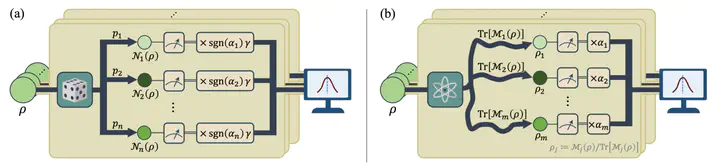
 Difference between (a) quasi-probability decomposition and (b) measurement-controlled post-processing.
Abstract
The manipulation of quantum states through linear maps beyond quantum operations has many important applications in various areas of quantum information processing. Current methods simulate unphysical maps by sampling physical operations according to classically determined probability distributions. In this work, we show that using quantum measurement instead leads to lower simulation costs for general Hermitian-preserving maps. Remarkably, we establish the equality between the simulation cost and the well-known diamond norm, thus closing a previously known gap and assigning diamond norm a universal operational meaning for all Hermitian-preserving maps. We demonstrate our method in two applications closely related to error mitigation and quantum machine learning, where it exhibits a favorable scaling. These findings highlight the power of quantum measurement in simulating unphysical operations, in which quantum interference is believed to play a vital role. Our work paves the way for more efficient sampling techniques and has the potential to be extended to more quantum information processing scenarios.
Lei Zhang
PhD Student (2023)
I obtained my BMath in AMath, CO & joint PMath from the University of Waterloo. My research interests include quantum algorithm design and quantum machine learning.
Benchi Zhao
Visiting Scholar
I obtained my MS degree in Physics from Imperial College London. I was an intern at Baidu Research under the supervision of Prof. Xin Wang. I obtained my PhD degree in quantum information at Osaka University. My research interests include quantum error mitigation, quantum information theory and quantum computation.
Xin Wang
Associate Professor
Prof. Xin Wang founded the QuAIR Lab at HKUST (Guangzhou) in June 2023. His research aims to advance our understanding of the limits of information processing with quantum systems and the potential of quantum artificial intelligence. His current interests include quantum algorithms, quantum resource theory, quantum machine learning, quantum computer architecture, and quantum error processing. Prior to establishing the QuAIR Lab, Prof. Wang was a Staff Researcher at the Institute for Quantum Computing at Baidu Research, where he focused on quantum computing research and the development of the Baidu Quantum Platform. Notably, he led the development of Paddle Quantum, a Python library for quantum machine learning. From 2018 to 2019, he was a Hartree Postdoctoral Fellow at the Joint Center for Quantum Information and Computer Science (QuICS) at the University of Maryland, College Park. Prof. Wang received his Ph.D. in quantum information from the University of Technology Sydney in 2018, under the supervision of Prof. Runyao Duan and Prof. Andreas Winter. He obtained his B.S. in mathematics (Wu Yuzhang Honors) from Sichuan University in 2014.