Estimate distillable entanglement and quantum capacity by squeezing useless entanglement
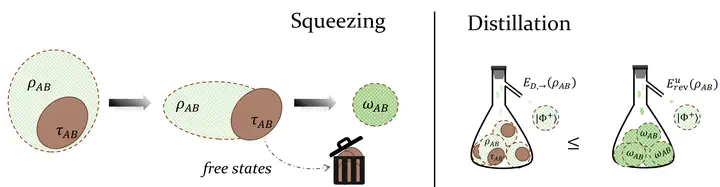 Illustration of the main result.
Abstract
Quantum Internet relies on quantum entanglement as a fundamental resource for secure and efficient quantum communication, reshaping data transmission. In this context, entanglement distillation emerges as a crucial process that plays a pivotal role in realizing the full potential of the quantum internet. Nevertheless, it remains challenging to accurately estimate the distillable entanglement and its closely related essential quantity, the quantum capacity. In this work, we consider a general resource measure known as the reverse divergence of resources which quantifies the minimum divergence between a target state and the set of free states. Leveraging this measure, we propose efficiently computable upper bounds for both quantities based on the idea that the useless entanglement within a state or a quantum channel does not contribute to the distillable entanglement or the quantum capacity, respectively. Our bounds can be computed via semidefinite programming and have practical applications for purifying maximally entangled states under practical noises, such as depolarizing and amplitude damping noises, leading to improvements in estimating the one-way distillable entanglement. Furthermore, we provide valuable benchmarks for evaluating the quantum capacities of qubit quantum channels, including the Pauli channels and the random mixed unitary channels, which are of great interest for the development of a quantum internet.
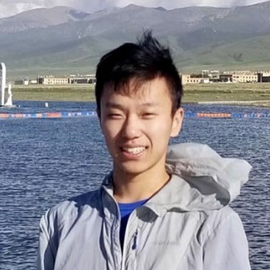
Chengkai Zhu
PhD Student (2023)
I obtained my BS in Applied Mathematics from China Agricultural University under the supervision of Prof. Zhencai Shen. I obtained my MS degree in Cyberspace Security from University of Chinese Academy of Sciences under the supervision of Prof. Zhenyu Huang. My research interests include quantum information theory and quantum computation.
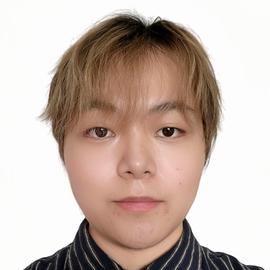
Chenghong Zhu
PhD Student (2023)
I obtained my BS and MS degrees in computer science from the University of Melbourne. My research interests include distributed quantum computing, quantum entanglement and quantum machine learning.
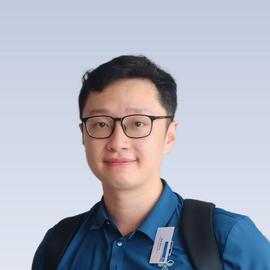
Xin Wang
Associate Professor
Prof. Xin Wang founded the QuAIR Lab at HKUST (Guangzhou) in June 2023. His research aims to advance our understanding of the limits of information processing with quantum systems and the potential of quantum artificial intelligence. His current interests include quantum algorithms, quantum resource theory, quantum machine learning, quantum computer architecture, and quantum error processing. Prior to establishing the QuAIR Lab, Prof. Wang was a Staff Researcher at the Institute for Quantum Computing at Baidu Research, where he focused on quantum computing research and the development of the Baidu Quantum Platform. Notably, he led the development of Paddle Quantum, a Python library for quantum machine learning. From 2018 to 2019, he was a Hartree Postdoctoral Fellow at the Joint Center for Quantum Information and Computer Science (QuICS) at the University of Maryland, College Park. Prof. Wang received his Ph.D. in quantum information from the University of Technology Sydney in 2018, under the supervision of Prof. Runyao Duan and Prof. Andreas Winter. He obtained his B.S. in mathematics (Wu Yuzhang Honors) from Sichuan University in 2014.