 Recognizing unknown Hamiltonians from X, Z
Abstract
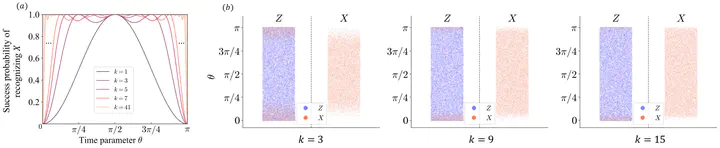
Identifying unknown Hamiltonians from their quantum dynamics is a pivotal challenge in quantum technologies and fundamental physics. In this paper, we introduce Hamiltonian recognition, a framework that bridges quantum hypothesis testing and quantum metrology, aiming to identify the Hamiltonian governing quantum dynamics from a known set of Hamiltonians. To identify $H$ for an unknown qubit quantum evolution $\exp(-iH\theta)$ with unknown $\theta$, from two or three orthogonal Hamiltonians, we develop a quantum algorithm for coherent function simulation, built on two quantum signal processing (QSP) structures. It can simultaneously realize a target polynomial based on measurement results regardless of the chosen signal unitary for the QSP. Utilizing semidefinite optimization and group representation theory, we prove that our methods achieve the optimal average success probability, taken over possible Hamiltonians $H$ and parameters $\theta$, decays as $O(1/k)$ with $k$ queries of the unknown unitary transformation. Furthermore, we demonstrate the validity of our protocol on a superconducting quantum processor. This work presents an efficient method to recognize Hamiltonians from limited queries of the dynamics, opening new avenues in composite channel discrimination and quantum metrology.

Chengkai Zhu
PhD Graduate

Shuyu He
Undergraduate Student
I am studying at The Hong Kong University of Science and Technology (Guangzhou). My research interests include quantum information theory and quantum computation.

Yu-Ao Chen
Visiting Scholar
I obtained my BS in Mathematics and Applied Mathematics from University of Science and Technology of China. I obtained my PhD degree in Applied Mathematics from University of Chinese Academy of Sciences under the supervision of Prof. Xiao-Shan Gao. My research interests include quantum computing, symbolic computation and cryptanalysis.
Lei Zhang
PhD Student (2023)
I obtained my BMath in AMath, CO & joint PMath from the University of Waterloo. My research interests include quantum algorithm design and quantum machine learning.

Xin Wang
Associate Professor
Prof. Xin Wang founded the QuAIR Lab at HKUST (Guangzhou) in June 2023. His research aims to advance our understanding of the limits of information processing with quantum systems and the potential of quantum artificial intelligence. His current interests include quantum algorithms, quantum resource theory, quantum machine learning, quantum computer architecture, and quantum error processing. Prior to establishing the QuAIR Lab, Prof. Wang was a Staff Researcher at the Institute for Quantum Computing at Baidu Research, where he focused on quantum computing research and the development of the Baidu Quantum Platform. Notably, he led the development of Paddle Quantum, a Python library for quantum machine learning. From 2018 to 2019, he was a Hartree Postdoctoral Fellow at the Joint Center for Quantum Information and Computer Science (QuICS) at the University of Maryland, College Park. Prof. Wang received his Ph.D. in quantum information from the University of Technology Sydney in 2018, under the supervision of Prof. Runyao Duan and Prof. Andreas Winter. He obtained his B.S. in mathematics (Wu Yuzhang Honors) from Sichuan University in 2014.