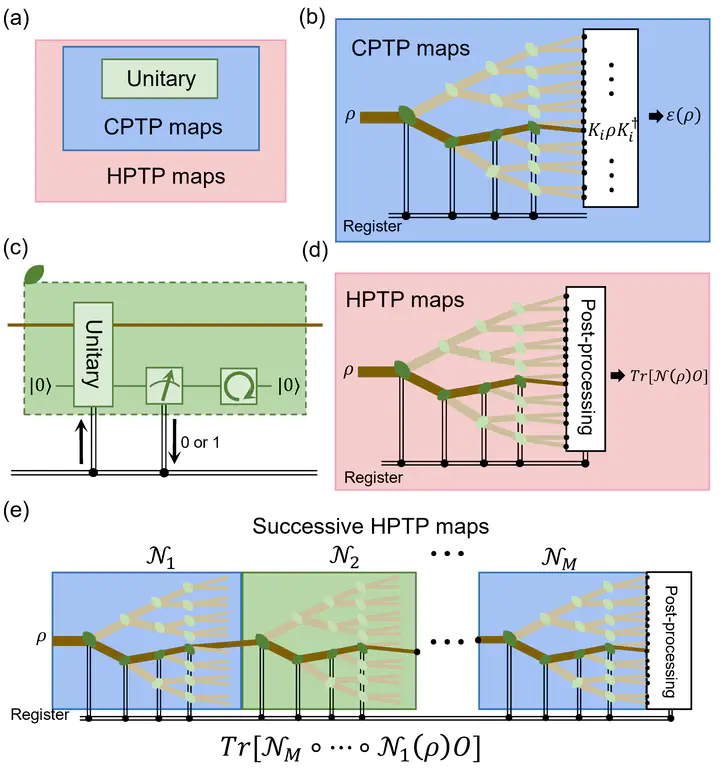
 Concept for HPTP maps and their realization.
Abstract
Quantum control has been a cornerstone of quantum information science, driving major advances in quantum computing, quantum communication, and quantum sensing. Over the years, it has enabled the implementation of arbitrary completely positive and trace-preserving (CPTP) maps; an important next step is to extend control to Hermitian-preserving and trace-preserving (HPTP) maps, which underpin applications such as entanglement detection, quantum error mitigation, quantum simulation, and quantum machine learning. Here we present an efficient and fully constructive method for implementing arbitrary HPTP maps. Unlike existing methods that decompose an HPTP map into multiple CPTP maps or approximate it using bipartite Hamiltonians with large Hilbert spaces, our approach compiles a target HPTP map into a single executable CPTP map whose Kraus rank is guaranteed to be no larger than the intrinsic rank of the target HPTP map plus one, followed by simple classical post-processing. Numerical results for inverse noise channels used in quantum error mitigation, including bosonic photon loss, confirm substantial reductions in resources and highlight scalability in higher-dimensional settings. Together with our numerical benchmarks, these results validate the efficiency and versatility of the proposed framework, opening a route to broader quantum-information applications enabled by HPTP processing.
Xin Wang
Associate Professor
Prof. Xin Wang founded the QuAIR Lab at HKUST (Guangzhou) in June 2023. His research aims to advance our understanding of the limits of information processing with quantum systems and the potential of quantum artificial intelligence. His current interests include quantum algorithms, quantum resource theory, quantum machine learning, quantum computer architecture, and quantum error processing. Prior to establishing the QuAIR Lab, Prof. Wang was a Staff Researcher at the Institute for Quantum Computing at Baidu Research, where he focused on quantum computing research and the development of the Baidu Quantum Platform. Notably, he led the development of Paddle Quantum, a Python library for quantum machine learning. From 2018 to 2019, he was a Hartree Postdoctoral Fellow at the Joint Center for Quantum Information and Computer Science (QuICS) at the University of Maryland, College Park. Prof. Wang received his Ph.D. in quantum information from the University of Technology Sydney in 2018, under the supervision of Prof. Runyao Duan and Prof. Andreas Winter. He obtained his B.S. in mathematics (Wu Yuzhang Honors) from Sichuan University in 2014.