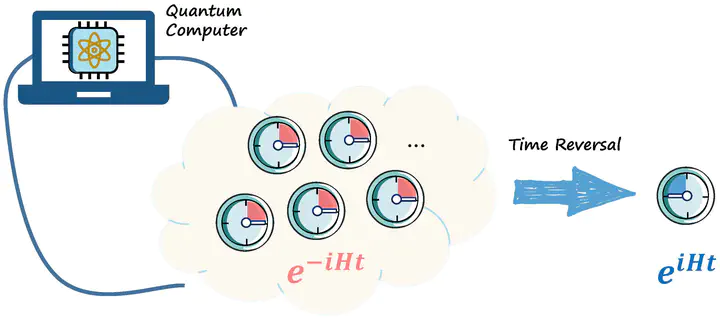
 Reversing an unknown unitary with finite calls of the unitary evolution.
Abstract
Reversing an unknown quantum evolution is of central importance to quantum information processing and fundamental physics, yet it remains a formidable challenge as conventional methods necessitate an infinite number of queries to fully characterize the quantum process. Here we introduce the Quantum Unitary Reversal Algorithm (QURA), a deterministic and exact approach to universally reverse arbitrary unknown unitary transformations using calls of the unitary, where is the system dimension. Our quantum algorithm resolves a fundamental problem of time-reversal simulations for closed quantum systems by confirming the feasibility of reversing any unitary evolution without knowing the exact process. The algorithm also provides the construction of a key oracle for unitary inversion in many quantum algorithm frameworks, such as quantum singular value transformation. It notably reveals a sharp boundary between the quantum and classical computing realms and unveils a quadratic quantum advantage in computational complexity for this foundational task.
Yu-Ao Chen
Visiting Scholar
I obtained my BS in Mathematics and Applied Mathematics from University of Science and Technology of China. I obtained my PhD degree in Applied Mathematics from University of Chinese Academy of Sciences under the supervision of Prof. Xiao-Shan Gao. My research interests include quantum computing, symbolic computation and cryptanalysis.
Yin Mo
Research Associate
I obtained my BS in Fundamental Science in Physics and Mathematics from Tsinghua University. I obtained my PhD degree in Computer Science from the University of Hong Kong. My research interests include quantum information theory, quantum supermaps and quantum machine learning.

Yingjian Liu
Alumni
Lei Zhang
PhD Student (2023)
I obtained my BMath in AMath, CO & joint PMath from the University of Waterloo. My research interests include quantum algorithm design and quantum machine learning.
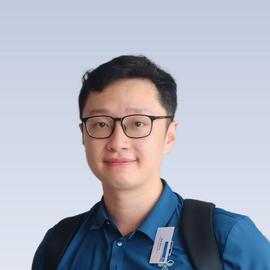
Xin Wang
Associate Professor
Prof. Xin Wang founded the QuAIR Lab at HKUST (Guangzhou) in June 2023. His research aims to advance our understanding of the limits of information processing with quantum systems and the potential of quantum artificial intelligence. His current interests include quantum algorithms, quantum resource theory, quantum machine learning, quantum computer architecture, and quantum error processing. Prior to establishing the QuAIR Lab, Prof. Wang was a Staff Researcher at the Institute for Quantum Computing at Baidu Research, where he focused on quantum computing research and the development of the Baidu Quantum Platform. Notably, he led the development of Paddle Quantum, a Python library for quantum machine learning. From 2018 to 2019, he was a Hartree Postdoctoral Fellow at the Joint Center for Quantum Information and Computer Science (QuICS) at the University of Maryland, College Park. Prof. Wang received his Ph.D. in quantum information from the University of Technology Sydney in 2018, under the supervision of Prof. Runyao Duan and Prof. Andreas Winter. He obtained his B.S. in mathematics (Wu Yuzhang Honors) from Sichuan University in 2014.