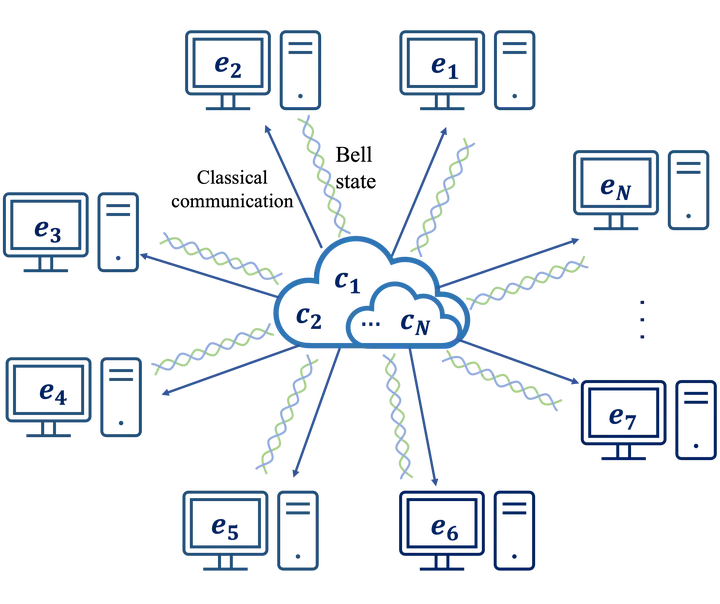
 A schematic representation of the central hub.
Abstract
Establishing a fully functional quantum internet relies on the efficient allocation of multipartite entangled states, which enables advanced quantum communication protocols, secure multipartite quantum key distribution, and distributed quantum computing. In this work, we propose local operations and classical communication (LOCC) protocols for allocating generalized $N$-qubit W and GHZ states within a centralized hub architecture, where the central hub node preshares Bell states with each end node. Our protocols deterministically and exactly distribute these states using only $N$ qubits of quantum memory within the central system, with communication costs of $2N - 2$ and $N$ classical bits for W and GHZ states, respectively. These resource-efficient protocols are further proven to be optimal within the centralized hub architecture, outperforming conventional teleportation protocols for entanglement distribution in both memory and communication costs. Our results provide a more resource-efficient method for allocating essential multipartite entangled states in quantum networks, paving the way for the realization of a quantum internet with enhanced efficiency.
Yu-Ao Chen
Visiting Scholar
I obtained my BS in Mathematics and Applied Mathematics from University of Science and Technology of China. I obtained my PhD degree in Applied Mathematics from University of Chinese Academy of Sciences under the supervision of Prof. Xiao-Shan Gao. My research interests include quantum computing, symbolic computation and cryptanalysis.

Xia Liu
Research Associate
I obtained my B.S. in Mathematics from the Qingdao University. I obtained my doctoral degree in Cyberspace Security from University of Chinese Academy of Sciences. My research interests include quantum machine learning and quantum computing.
Chenghong Zhu
PhD Student (2023)
I obtained my BS and MS degrees in computer science from the University of Melbourne. My research interests include distributed quantum computing, quantum entanglement and quantum machine learning.
Lei Zhang
PhD Student (2023)
I obtained my BMath in AMath, CO & joint PMath from the University of Waterloo. My research interests include quantum algorithm design and quantum machine learning.
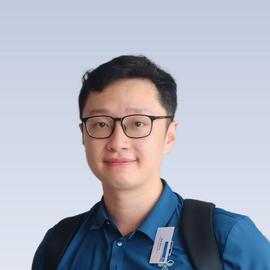
Xin Wang
Associate Professor
Prof. Xin Wang founded the QuAIR Lab at HKUST (Guangzhou) in June 2023. His research aims to advance our understanding of the limits of information processing with quantum systems and the potential of quantum artificial intelligence. His current interests include quantum algorithms, quantum resource theory, quantum machine learning, quantum computer architecture, and quantum error processing. Prior to establishing the QuAIR Lab, Prof. Wang was a Staff Researcher at the Institute for Quantum Computing at Baidu Research, where he focused on quantum computing research and the development of the Baidu Quantum Platform. Notably, he led the development of Paddle Quantum, a Python library for quantum machine learning. From 2018 to 2019, he was a Hartree Postdoctoral Fellow at the Joint Center for Quantum Information and Computer Science (QuICS) at the University of Maryland, College Park. Prof. Wang received his Ph.D. in quantum information from the University of Technology Sydney in 2018, under the supervision of Prof. Runyao Duan and Prof. Andreas Winter. He obtained his B.S. in mathematics (Wu Yuzhang Honors) from Sichuan University in 2014.