Abstract
Quantum entanglement is a key resource in quantum technology, and its quantification is a vital task in the current Noisy Intermediate-Scale Quantum (NISQ) era. This paper combines hybrid quantum-classical computation and quasi-probability decomposition to propose two variational quantum algorithms, called Variational Entanglement Detection (VED) and Variational Logarithmic Negativity Estimation (VLNE), for detecting and quantifying entanglement on near-term quantum devices, respectively. VED makes use of the positive map criterion and works as follows. Firstly, it decomposes a positive map into a combination of quantum operations implementable on near-term quantum devices. It then variationally estimates the minimal eigenvalue of the final state, obtained by executing these implementable operations on the target state and averaging the output states. Deterministic and probabilistic methods are proposed to compute the average. At last, it asserts that the target state is entangled if the optimized minimal eigenvalue is negative. VLNE builds upon a linear decomposition of the transpose map into Pauli terms and the recently proposed trace distance estimation algorithm. It variationally estimates the well-known logarithmic negativity entanglement measure and could be applied to quantify entanglement on near-term quantum devices. Experimental and numerical results on the Bell state, isotropic states, and Breuer states show the validity of the proposed entanglement detection and quantification methods.
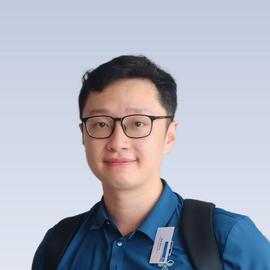
Xin Wang
Associate Professor
Prof. Xin Wang founded the QuAIR Lab at HKUST (Guangzhou) in June 2023. His research aims to advance our understanding of the limits of information processing with quantum systems and the potential of quantum artificial intelligence. His current interests include quantum algorithms, quantum resource theory, quantum machine learning, quantum computer architecture, and quantum error processing. Prior to establishing the QuAIR Lab, Prof. Wang was a Staff Researcher at the Institute for Quantum Computing at Baidu Research, where he focused on quantum computing research and the development of the Baidu Quantum Platform. Notably, he led the development of Paddle Quantum, a Python library for quantum machine learning. From 2018 to 2019, he was a Hartree Postdoctoral Fellow at the Joint Center for Quantum Information and Computer Science (QuICS) at the University of Maryland, College Park. Prof. Wang received his Ph.D. in quantum information from the University of Technology Sydney in 2018, under the supervision of Prof. Runyao Duan and Prof. Andreas Winter. He obtained his B.S. in mathematics (Wu Yuzhang Honors) from Sichuan University in 2014.