Abstract
Measurements on near-term quantum processors are inevitably subject to hardware imperfections that lead to readout errors. Mitigation of such unavoidable errors is crucial to better explore and extend the power of near-term quantum hardware. In this work, we propose a method to mitigate measurement errors in computing quantum expectation values using the truncated Neumann series. The essential idea is to cancel the errors by combining various noisy expectation values generated by sequential measurements determined by terms in the truncated series. We numerically test this method and find that the computation accuracy is substantially improved. Our method possesses several advantages: it does not assume any noise structure, it does not require the calibration procedure to learn the noise matrix a prior, and most importantly, the incurred error mitigation overhead is independent of system size, as long as the noise resistance of the measurement device is moderate. All these advantages empower our method as a practical measurement error mitigation method for near-term quantum devices.
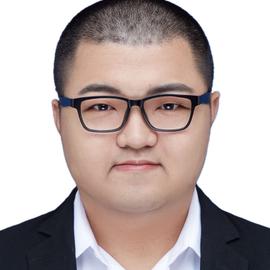
Yu-Ao Chen
Visiting Scholar
I obtained my BS in Mathematics and Applied Mathematics from University of Science and Technology of China. I obtained my PhD degree in Applied Mathematics from University of Chinese Academy of Sciences under the supervision of Prof. Xiao-Shan Gao. My research interests include quantum computing, symbolic computation and cryptanalysis.
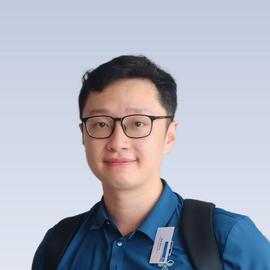
Xin Wang
Associate Professor
Prof. Xin Wang founded the QuAIR Lab at HKUST (Guangzhou) in June 2023. His research aims to advance our understanding of the limits of information processing with quantum systems and the potential of quantum artificial intelligence. His current interests include quantum algorithms, quantum resource theory, quantum machine learning, quantum computer architecture, and quantum error processing. Prior to establishing the QuAIR Lab, Prof. Wang was a Staff Researcher at the Institute for Quantum Computing at Baidu Research, where he focused on quantum computing research and the development of the Baidu Quantum Platform. Notably, he led the development of Paddle Quantum, a Python library for quantum machine learning. From 2018 to 2019, he was a Hartree Postdoctoral Fellow at the Joint Center for Quantum Information and Computer Science (QuICS) at the University of Maryland, College Park. Prof. Wang received his Ph.D. in quantum information from the University of Technology Sydney in 2018, under the supervision of Prof. Runyao Duan and Prof. Andreas Winter. He obtained his B.S. in mathematics (Wu Yuzhang Honors) from Sichuan University in 2014.