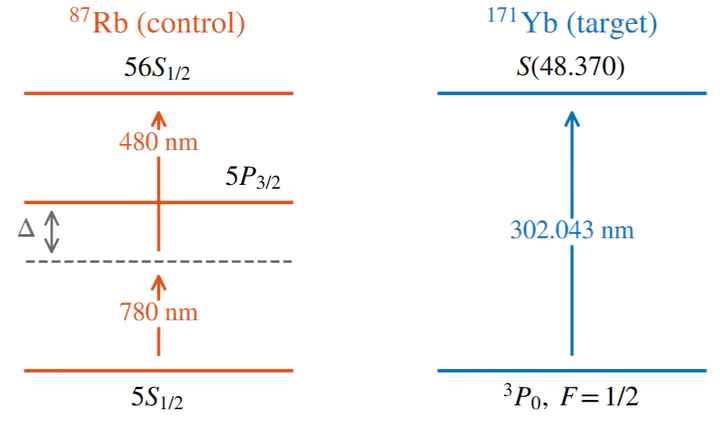
 Optical excitation schemes.
Abstract
Neutral-atom tweezer arrays support scalable quantum information processing. Dual-species ${}^{87}Rb–{}^{171}Yb$ arrays combine long-lived ytterbium nuclear-spin data qubits with fast, species-selective rubidium ancilla control and readout. However, realizing interspecies gates without inducing destructive Stark mixing in divalent atoms remains an outstanding problem. Here, we identify an optically accessible $S+S \leftrightarrow P+P$ Forster resonance at zero electric field, providing strong dipole-dipole exchange at array pitch. Using a shaped optical pulse under finite control response, we demonstrate a $0.36 \mu s$ exchange-assisted controlled-$Z$ gate with an intrinsic fidelity of $99.91%$, remaining above $99.85%$ under bounded perturbations. We also identify an auxiliary repulsive van der Waals channel, providing a comprehensive toolbox for hybrid quantum processors.
Erdong Huang
PhD Student (2024)
I obtained my BS in Applied Physics from Beijing Institute of Technology, Zhuhai (BITZ). I obtained my MSc degree in Physics from The Chinese University of Hong Kong. My research interests include quantum hardware, quantum information theory and quantum computing.
Mingrui Jing
PhD Student (2023)
I obtained my BS and MS degrees in physics from the University of Melbourne. My research interests include distributed quantum computing, quantum entanglement and quantum machine learning.
Hongshun Yao
PhD Student (2024)
I obtained my BS degree in Mathematics from Nanjing University of Aeronautics and Astronautics and my MS degree in Mathematics from Beihang University. My research interests include quantum information theory and quantum machine learning.
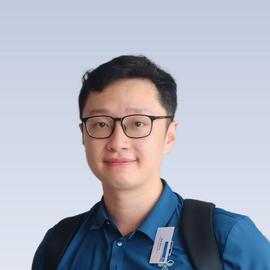
Xin Wang
Associate Professor
Prof. Xin Wang founded the QuAIR Lab at HKUST (Guangzhou) in June 2023. His research aims to advance our understanding of the limits of information processing with quantum systems and the potential of quantum artificial intelligence. His current interests include quantum algorithms, quantum resource theory, quantum machine learning, quantum computer architecture, and quantum error processing. Prior to establishing the QuAIR Lab, Prof. Wang was a Staff Researcher at the Institute for Quantum Computing at Baidu Research, where he focused on quantum computing research and the development of the Baidu Quantum Platform. Notably, he led the development of Paddle Quantum, a Python library for quantum machine learning. From 2018 to 2019, he was a Hartree Postdoctoral Fellow at the Joint Center for Quantum Information and Computer Science (QuICS) at the University of Maryland, College Park. Prof. Wang received his Ph.D. in quantum information from the University of Technology Sydney in 2018, under the supervision of Prof. Runyao Duan and Prof. Andreas Winter. He obtained his B.S. in mathematics (Wu Yuzhang Honors) from Sichuan University in 2014.