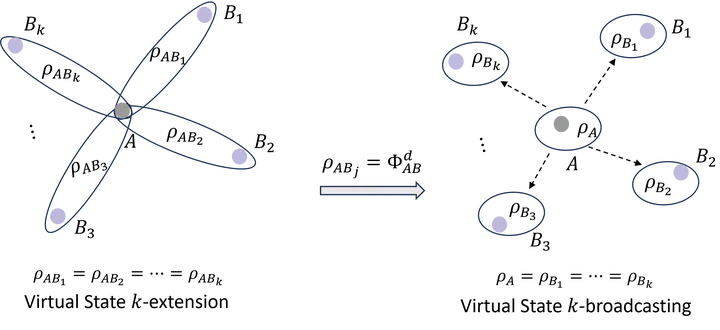
 Diagram of state k-extension.
Abstract
Monogamy of entanglement, which limits how entanglement can be shared among multiple parties, is a fundamental feature underpinning the privacy of quantum communication. In this work, we introduce a novel operational framework to quantify the unshareability or unextendibility of entanglement via a virtual state-extension task. The virtual extension cost is defined as the minimum simulation cost of a randomized protocol that reproduces the marginals of a $k$-extension. For the important family of isotropic states, we derive an exact closed-form expression for this cost. Our central result establishes a tight connection: the virtual extension cost of a maximally entangled state equals the optimal simulation cost of universal virtual quantum broadcasting. Using the algebra of partially transposed permutation matrices, we obtain an analytical formula and construct an explicit quantum circuit for the optimal broadcasting protocol, thereby resolving an open question in quantum broadcasting. We further relate the virtual extension cost to the absolute robustness of unextendibility, providing it with a clear operational meaning, and show that the virtual extension cost is an entanglement measure that bounds distillable entanglement and connects to logarithmic negativity.
Hongshun Yao
PhD Student (2024)
I obtained my BS degree in Mathematics from Nanjing University of Aeronautics and Astronautics and my MS degree in Mathematics from Beihang University. My research interests include quantum information theory and quantum machine learning.

Jingu Xie
PhD Student (2026)
I am currently studying at the Quantum AI Research Lab, Thrust of Artificial Intelligence, Information Hub, The Hong Kong University of Science and Technology (Guangzhou). My research interests include quantum information theory, quantum computation, and applied mathematics.
Chengkai Zhu
PhD Student (2023)
I obtained my BS in Applied Mathematics from China Agricultural University under the supervision of Prof. Zhencai Shen. I obtained my MS degree in Cyberspace Security from University of Chinese Academy of Sciences under the supervision of Prof. Zhenyu Huang. My research interests include quantum information theory and quantum computation.
Ranyiliu Chen
Visiting Scholar
I received my doctorate in Mathematics from the University of Copenhagen in 2025, under the supervision of Prof. Laura Mancinska. Previously I obtained my master’s and bachelor’s degrees in 2020 and 2017 respectively, both in electronic engineering from Beihang University. My research interests include quantum information theory, Bell non-locality and quantum machine learning.
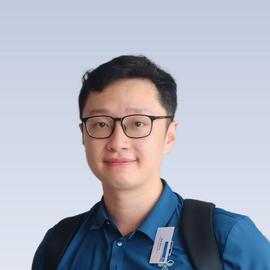
Xin Wang
Associate Professor
Prof. Xin Wang founded the QuAIR Lab at HKUST (Guangzhou) in June 2023. His research aims to advance our understanding of the limits of information processing with quantum systems and the potential of quantum artificial intelligence. His current interests include quantum algorithms, quantum resource theory, quantum machine learning, quantum computer architecture, and quantum error processing. Prior to establishing the QuAIR Lab, Prof. Wang was a Staff Researcher at the Institute for Quantum Computing at Baidu Research, where he focused on quantum computing research and the development of the Baidu Quantum Platform. Notably, he led the development of Paddle Quantum, a Python library for quantum machine learning. From 2018 to 2019, he was a Hartree Postdoctoral Fellow at the Joint Center for Quantum Information and Computer Science (QuICS) at the University of Maryland, College Park. Prof. Wang received his Ph.D. in quantum information from the University of Technology Sydney in 2018, under the supervision of Prof. Runyao Duan and Prof. Andreas Winter. He obtained his B.S. in mathematics (Wu Yuzhang Honors) from Sichuan University in 2014.