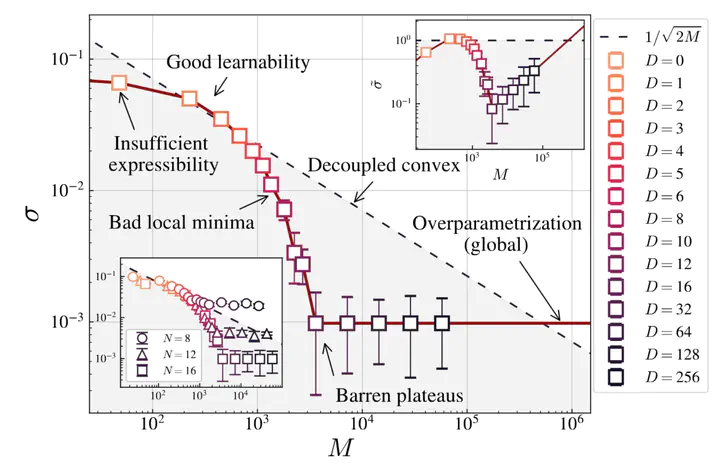
 Landscape fluctuation for the 1D cluster model
Abstract
The conflict between trainability and expressibility is a key challenge in variational quantum computing and quantum machine learning. Resolving this conflict necessitates designing specific quantum neural networks (QNN) tailored for specific problems, which urgently needs a general and efficient method to predict the learnability of QNNs without costly training. In this work, we demonstrate a simple and efficient metric for learnability by comparing the fluctuations of the given training landscape with standard learnable landscapes. This metric shows surprising effectiveness in predicting learnability as it unifies the effects of insufficient expressibility, barren plateaus, bad local minima, and overparametrization. Importantly, it can be estimated efficiently on classical computers via Clifford sampling without actual training on quantum devices. We conduct extensive numerical experiments to validate its effectiveness regarding physical and random Hamiltonians. We also prove a compact lower bound for the metric in locally scrambled circuits as analytical guidance. Our findings enable efficient predictions of learnability, allowing fast selection of suitable QNN architectures for a given problem without training, which can greatly improve the efficiency especially when access to quantum devices is limited.
Chenghong Zhu
PhD Student (2023)
I obtained my BS and MS degrees in computer science from the University of Melbourne. My research interests include distributed quantum computing, quantum entanglement and quantum machine learning.
Xin Wang
Associate Professor
Prof. Xin Wang founded the QuAIR Lab at HKUST (Guangzhou) in June 2023. His research aims to advance our understanding of the limits of information processing with quantum systems and the potential of quantum artificial intelligence. His current interests include quantum algorithms, quantum resource theory, quantum machine learning, quantum computer architecture, and quantum error processing. Prior to establishing the QuAIR Lab, Prof. Wang was a Staff Researcher at the Institute for Quantum Computing at Baidu Research, where he focused on quantum computing research and the development of the Baidu Quantum Platform. Notably, he led the development of Paddle Quantum, a Python library for quantum machine learning. From 2018 to 2019, he was a Hartree Postdoctoral Fellow at the Joint Center for Quantum Information and Computer Science (QuICS) at the University of Maryland, College Park. Prof. Wang received his Ph.D. in quantum information from the University of Technology Sydney in 2018, under the supervision of Prof. Runyao Duan and Prof. Andreas Winter. He obtained his B.S. in mathematics (Wu Yuzhang Honors) from Sichuan University in 2014.