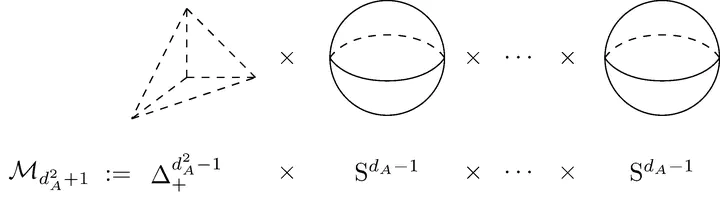
 Optimizing Holevo capacity on a Cartesian product of manifolds
Abstract
Computing the classical capacity of a noisy quantum channel is crucial for understanding the limits of communication over quantum channels. However, its evaluation remains challenging due to the difficulty of computing the Holevo capacity and the even greater difficulty of regularization. In this work, we formulate the computation of the Holevo capacity as an optimization problem on a product manifold constructed from probability distributions and their corresponding pure input states for a quantum channel. A Riemannian gradient descent algorithm is proposed to solve the problem, providing lower bounds on the classical capacity of general quantum channels and outperforming existing methods in numerical experiments in both efficiency and scale.
Chengkai Zhu
PhD Student (2023)
I obtained my BS in Applied Mathematics from China Agricultural University under the supervision of Prof. Zhencai Shen. I obtained my MS degree in Cyberspace Security from University of Chinese Academy of Sciences under the supervision of Prof. Zhenyu Huang. My research interests include quantum information theory and quantum computation.
Xin Wang
Associate Professor
Prof. Xin Wang founded the QuAIR Lab at HKUST (Guangzhou) in June 2023. His research aims to advance our understanding of the limits of information processing with quantum systems and the potential of quantum artificial intelligence. His current interests include quantum algorithms, quantum resource theory, quantum machine learning, quantum computer architecture, and quantum error processing. Prior to establishing the QuAIR Lab, Prof. Wang was a Staff Researcher at the Institute for Quantum Computing at Baidu Research, where he focused on quantum computing research and the development of the Baidu Quantum Platform. Notably, he led the development of Paddle Quantum, a Python library for quantum machine learning. From 2018 to 2019, he was a Hartree Postdoctoral Fellow at the Joint Center for Quantum Information and Computer Science (QuICS) at the University of Maryland, College Park. Prof. Wang received his Ph.D. in quantum information from the University of Technology Sydney in 2018, under the supervision of Prof. Runyao Duan and Prof. Andreas Winter. He obtained his B.S. in mathematics (Wu Yuzhang Honors) from Sichuan University in 2014.