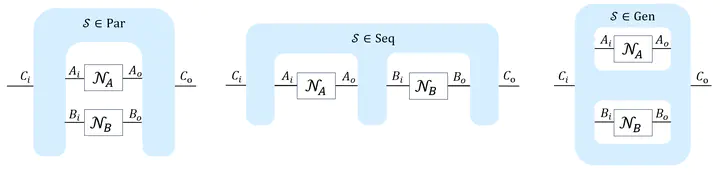
 Comparison of higher-order architectures.
Abstract
Higher-order quantum transformations allow multiple channel uses to be combined through different causal architectures, from parallel and fixed-order sequential networks to general higher-order processes. Whether this causal freedom improves channel transformation when the higher-order operation is also constrained by a resource theory remains largely unexplored. We study this question in the dynamical resource theory of coherence using a unified semidefinite-programming framework. For two qubit amplitude-damping channels and the identity target, we prove a strict causal hierarchy at every nontrivial damping strength under both maximally incoherent superchannels (MISC) and dephasing-covariant incoherent superchannels (DISC). In contrast, mixed-Pauli channels admit a common teleportation simulation that transfers the channel dependence to Bell-diagonal program states prepared in parallel. The remaining processing can then be absorbed into a single quantum operational, so parallel, fixed-order sequential, and general higher-order strategies achieve the same optimal error for any target. These results identify free program-state parallelisation as a structural obstruction to causal enhancement.
Lin Zhu
PhD Student (2025)
I obtained my MEng in Materials Science in University of Oxford under the supervision of Prof. Simon Benjamin. My research interests include quantum information theory, quantum computation and quantum hardware
Benchi Zhao
Visiting Scholar
I obtained my MS degree in Physics from Imperial College London. I was an intern at Baidu Research under the supervision of Prof. Xin Wang. I obtained my PhD degree in quantum information at Osaka University. My research interests include quantum error mitigation, quantum information theory and quantum computation.
Ranyiliu Chen
Visiting Scholar
I received my doctorate in Mathematics from the University of Copenhagen in 2025, under the supervision of Prof. Laura Mancinska. Previously I obtained my master’s and bachelor’s degrees in 2020 and 2017 respectively, both in electronic engineering from Beihang University. My research interests include quantum information theory, Bell non-locality and quantum machine learning.
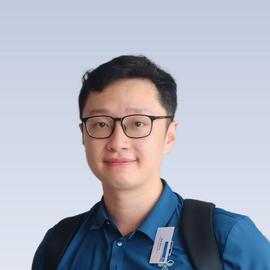
Xin Wang
Associate Professor
Prof. Xin Wang founded the QuAIR Lab at HKUST (Guangzhou) in June 2023. His research aims to advance our understanding of the limits of information processing with quantum systems and the potential of quantum artificial intelligence. His current interests include quantum algorithms, quantum resource theory, quantum machine learning, quantum computer architecture, and quantum error processing. Prior to establishing the QuAIR Lab, Prof. Wang was a Staff Researcher at the Institute for Quantum Computing at Baidu Research, where he focused on quantum computing research and the development of the Baidu Quantum Platform. Notably, he led the development of Paddle Quantum, a Python library for quantum machine learning. From 2018 to 2019, he was a Hartree Postdoctoral Fellow at the Joint Center for Quantum Information and Computer Science (QuICS) at the University of Maryland, College Park. Prof. Wang received his Ph.D. in quantum information from the University of Technology Sydney in 2018, under the supervision of Prof. Runyao Duan and Prof. Andreas Winter. He obtained his B.S. in mathematics (Wu Yuzhang Honors) from Sichuan University in 2014.