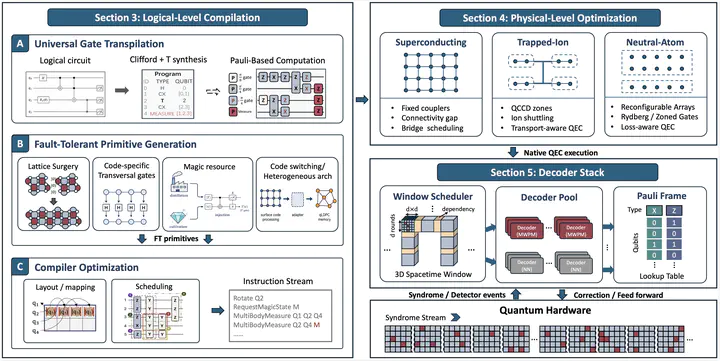
 Overall picture of the QEC-protected quantum computing stack.
Abstract
Scalable quantum computation is expected to rely on fault-tolerant quantum computation (FTQC), in which quantum error correction (QEC) suppresses physical errors sufficiently to support reliable logical operations. This requires quantum compilation to move beyond general-purpose circuit optimization toward encoding-aware and protocol-structured compilation across the full stack of fault-tolerant quantum computers. Beyond circuit synthesis and hardware mapping, an FTQC compiler must lower algorithm-level operations into the logical gate set supported by the chosen code, coordinate encoded data and ancilla resources, realize logical operations together with repeated syndrome extraction under hardware constraints, and provide the resulting measurement stream to real-time decoding. This survey presents a full-stack view of compiler design for QEC-protected quantum computation. We organize existing work into three interacting layers: logical-level QEC compilation, physical-level QEC realization, and decoder runtime integration. At the logical level, we review surface-code lattice-surgery compilers, beyond-surface-code code-surgery frameworks including emerging qLDPC approaches, and compilation support for non-Clifford operations such as magic-state distillation and code switching. At the physical level, we survey hardware-aware QEC realization on superconducting, trapped-ion, and neutral-atom platforms. We further examine decoder models, real-time decoding systems, and frame-management mechanisms that close the feedback loop during fault-tolerant execution. Finally, we identify open challenges in cross-layer optimization, qLDPC compilation, compiler-decoder co-design, runtime adaptivity, and the development of integrated and benchmarkable FTQC compilation stacks. An actively maintained paper list is available at: this http URL.
Chenghong Zhu
PhD Graduate
Jiahan Chen
PhD Student (2025)
I obtained my BS in Computer Science and Technology from Xi’an Jiaotong University. I obtained my MS degree in Computer Science and Technology from Harbin Institute of Technology, Shenzhen. My research interests include quantum information theory and quantum error correction.
Keming He
PhD Student (2024)
I obtained my BS in Electronic Information Science and Technology from Chongqing University. I obtained my MS degree in Electrical Engineering from University of Southern California. My research interests include quantum information theory and quantum error correction.
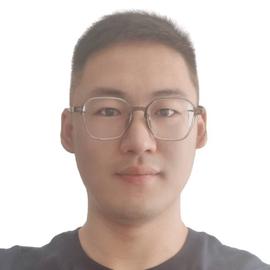
Hongshun Yao
PhD Student (2024)
I obtained my BS degree in Mathematics from Nanjing University of Aeronautics and Astronautics and my MS degree in Mathematics from Beihang University. My research interests include quantum information theory and quantum machine learning.
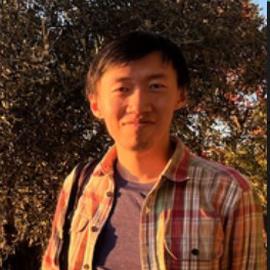
Xiaotong Ni
Alumni
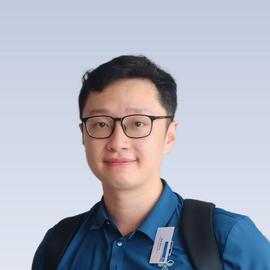
Xin Wang
Associate Professor
Prof. Xin Wang founded the QuAIR Lab at HKUST (Guangzhou) in June 2023. His research aims to advance our understanding of the limits of information processing with quantum systems and the potential of quantum artificial intelligence. His current interests include quantum algorithms, quantum resource theory, quantum machine learning, quantum computer architecture, and quantum error processing. Prior to establishing the QuAIR Lab, Prof. Wang was a Staff Researcher at the Institute for Quantum Computing at Baidu Research, where he focused on quantum computing research and the development of the Baidu Quantum Platform. Notably, he led the development of Paddle Quantum, a Python library for quantum machine learning. From 2018 to 2019, he was a Hartree Postdoctoral Fellow at the Joint Center for Quantum Information and Computer Science (QuICS) at the University of Maryland, College Park. Prof. Wang received his Ph.D. in quantum information from the University of Technology Sydney in 2018, under the supervision of Prof. Runyao Duan and Prof. Andreas Winter. He obtained his B.S. in mathematics (Wu Yuzhang Honors) from Sichuan University in 2014.