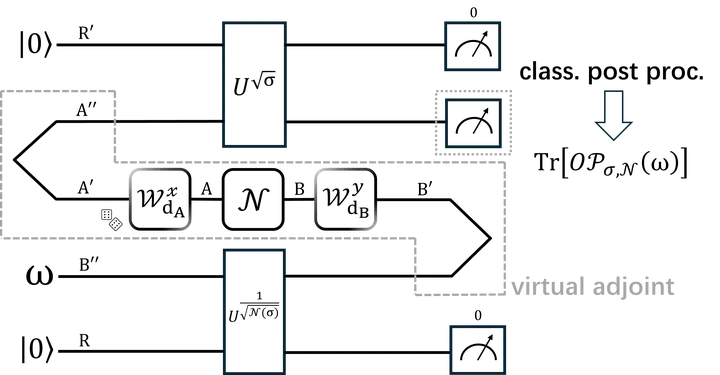
 Simulation of Petz recovery map.
Abstract
Transformations of quantum channels, such as the transpose, complex conjugate, and adjoint, are fundamental to quantum information theory. Given access to an unknown channel, a central problem is whether these transformations can be implemented physically with quantum supermaps. While such supermaps are known for unitary operations, the situation for general quantum channels is fundamentally different. In this work, we establish a strict hierarchy of physical realizability for the transposition, complex conjugation, and adjoint transformation of an unknown quantum channel. We present a probabilistic protocol that exactly implements the transpose with a single query. In contrast, we prove no-go theorems showing that neither the complex conjugate nor the adjoint can be implemented by any completely positive supermap, even probabilistically. We then overcome this impossibility by designing a virtual protocol for the complex conjugate based on quasi-probability decomposition, and show its optimality in terms of the diamond norm. As a key application, we propose a protocol to estimate the expectation values resulting from the Petz recovery map of an unknown channel, achieving an improved query complexity compared to existing methods.

Chengkai Zhu
PhD Student (2023)
I obtained my BS in Applied Mathematics from China Agricultural University under the supervision of Prof. Zhencai Shen. I obtained my MS degree in Cyberspace Security from University of Chinese Academy of Sciences under the supervision of Prof. Zhenyu Huang. My research interests include quantum information theory and quantum computation.
Ziao Tang
PhD Student (co, 2025)
I obtained my BSc in Mathematics from the University of Hong Kong. My research interests include quantum information and quantum computing.
Guocheng Zhen
PhD Student (2025)
I have received my bachelor's degree in mathematics from Wuhan University in 2022 and my master's degree in mathematics from Wuhan University in 2025. My main research is about probability theory, especially Large Random Dimension Matrices Theory. I am exploring the mathematical foundation in quantum information under the guidance of Prof. Xin Wang and Prof. Bartosz Regula.

Xin Wang
Associate Professor
Prof. Xin Wang founded the QuAIR Lab at HKUST (Guangzhou) in June 2023. His research aims to advance our understanding of the limits of information processing with quantum systems and the potential of quantum artificial intelligence. His current interests include quantum algorithms, quantum resource theory, quantum machine learning, quantum computer architecture, and quantum error processing. Prior to establishing the QuAIR Lab, Prof. Wang was a Staff Researcher at the Institute for Quantum Computing at Baidu Research, where he focused on quantum computing research and the development of the Baidu Quantum Platform. Notably, he led the development of Paddle Quantum, a Python library for quantum machine learning. From 2018 to 2019, he was a Hartree Postdoctoral Fellow at the Joint Center for Quantum Information and Computer Science (QuICS) at the University of Maryland, College Park. Prof. Wang received his Ph.D. in quantum information from the University of Technology Sydney in 2018, under the supervision of Prof. Runyao Duan and Prof. Andreas Winter. He obtained his B.S. in mathematics (Wu Yuzhang Honors) from Sichuan University in 2014.